
The blueprint for more and better housing
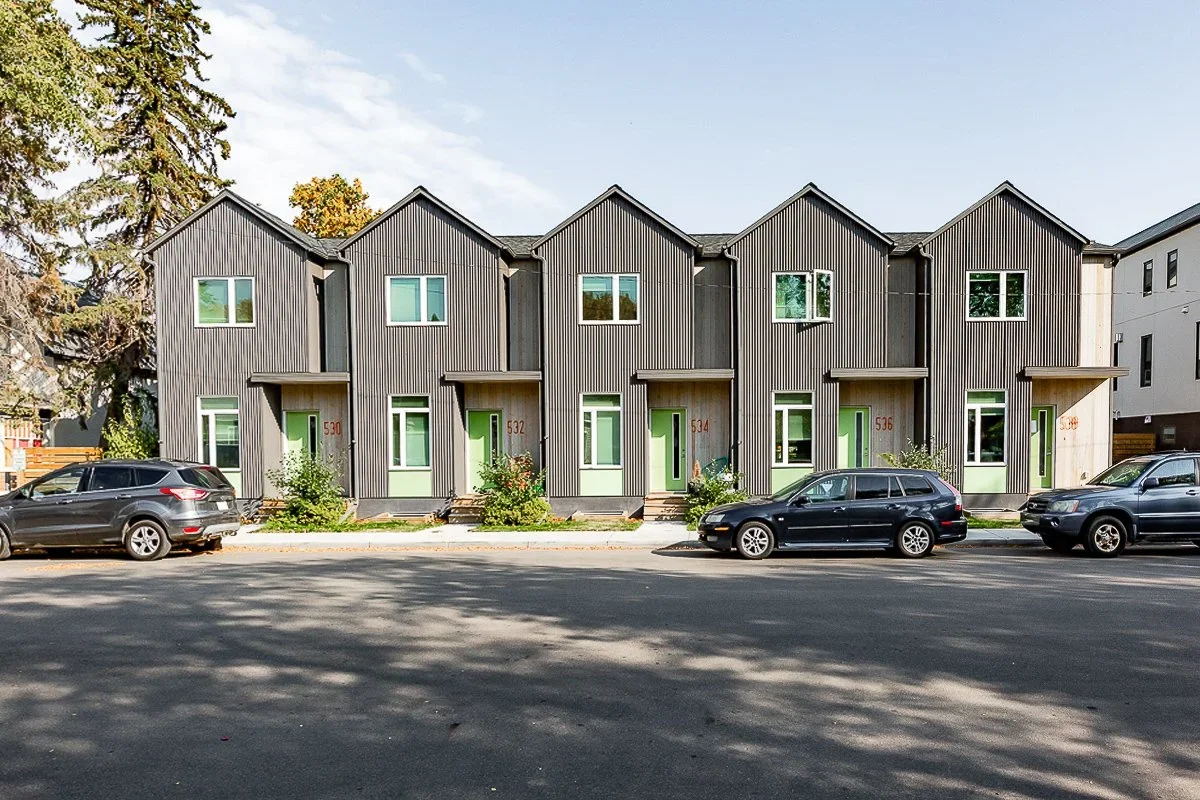
How federal, provincial and municipal governments can ensure we build 5.8M new homes that are affordable, low-carbon and resilient.
This report, originally published March 2024, rises to the challenge posed by CMHC’s 2022 report on housing shortages: Canada needs 5.8 million new homes by 2030 to restore housing affordability. This is a historic opportunity to build more and better housing for a fast-growing population of homeowners, renters, seniors, young families, students and precariously housed.
What does it mean to build more and better housing? For the Task Force for Housing & Climate, as for up to 85 percent of Canadians, it means making it affordable, making it low-carbon, and making it resilient to the worsening impacts of climate change, while also making it at scale to hit our housing targets.
Federal, provincial and municipal governments all have a critical role to play in achieving these goals. The Blueprint for More and Better Housing provides governments with clear recommendations and practical policy actions to do it. It offers ten recommendations across all orders of government, supported by 50 specific policy actions for the federal government, 50 specific policy actions for provincial governments, and 40 specific policy actions for municipal governments.
Emerging from the numerous important takeaways are some key “game-changers”. These are policy moves that, when coordinated across all orders of government, could transform Canada’s housing landscape and go a long way toward delivering the more and better homes that Canadians deserve.
Legalize density: Focusing housing growth in cities and communities, where there is existing infrastructure like roads and water lines, is faster, less costly, lower carbon and more resilient.
Implement better building codes: Better building form can reduce operating costs, cut emissions, and improve resilience.
Invest in factory-built housing: Factory-built housing and other process and material innovations can speed up construction, reduce costs, and systematize energy-efficient and climate-resilient features.
Don’t build in high-risk areas: The most expensive home is the one you need to rebuild after an extreme weather event.
The urgency of the moment calls for quick action. Governments across Canada have taken constructive steps over the past months to address a crippling housing crisis and a dangerous climate crisis, but there is a long way to go. The Blueprint for More and Better Housing can guide our next steps while inspiring greater ambition, greater coordination and greater innovation.
-
Tie all federal infrastructure, transit, and housing funding to provincial and municipal adoption of pro-density legalization reforms, including eliminating unit maximums on all forms of residential housing, abolishing parking minimums on residential, commercial, and industrial properties, legalizing the construction of CMHC pre-approved housing designs as-of-right, and ambitious as-of-right density permissions near transit.
Develop a robust innovation strategy to accelerate housing innovations ranging from mass timber and decarbonized cement to panelization and other factory-built housing approaches. The strategy should incorporate:
Tax reforms, including eliminating the GST/PST on purpose-built rental projects, increasing the threshold for the GST housing rebate, introducing a Housing Technology Investment Tax Credit, implementing an accelerated capital cost allowance for purpose-built rental construction, and providing a full HST exemption for charitable non-profit organizations.
A rebalanced immigration strategy that increases the number of skilled trade workers and exempts skilled trades programs from international student visa caps.
A financing strategy that includes low-cost and long-term fixed-rate financing for municipalities to facilitate land acquisition, financing to scale the not-for-profit housing sector, and a fund to build additional student residences across Canada. The financing strategy should allow not-for-profit housing providers to stack financing programs.
A procurement strategy for homes in CMHC’s pre-approved catalogue, including guaranteed minimum orders.
Immediately overhaul the National Model Building Codes to simplify and harmonize requirements, integrate physical climate resilience measures, and support integration with local building performance standards to reflect changing regional climate risks.
Increase coordination and evidence-based decision-making by:
Providing detailed annual population forecasts, incorporating policy developments such as changes to immigration targets, which should be used as the basis for housing targets for each order of government, with incentives provided to governments that exceed their annual targets.
Mandating the CMHC to develop a Comprehensive Housing Data Repository.
Designing and adopting national standards for Building Information Modeling, a Climate Resilience Residential Rating, and Community Resilience, and implementing a Nationwide Hazard Mapping Initiative.
Collaborate with First Nations, Métis and Inuit Peoples to enable Indigenous-led housing development projects and to support culturally appropriate housing solutions that ensure access to safe and adequate housing and help advance self-determination and reconciliation.
Work with provinces and municipalities to improve the mapping of climate impacts such as flood and wildfire hazards while ensuring government funds do not support housing and infrastructure development in areas identified as high-risk.
-
Legalize density in existing communities by eliminating unit maximums on all forms of residential housing and abolishing parking minimums on residential, commercial, and industrial properties, by legalizing the construction of CMHC pre-approved housing designs as-of-right, and by adopting ambitious as-of-right density permissions near transit.
-
Legalize density by eliminating unit maximums on all forms of residential housing and abolishing parking minimums on residential, commercial, and industrial properties, by legalizing the construction of CMHC pre-approved housing designs as-of-right, and by adopting ambitious as-of-right density permissions adjacent to transit lines.
Create a more permissive land use, planning and approvals system, including by repealing policies, zoning or plans that prioritize the preservation of the physical character of the neighbourhood, and by exempting from site plan approval and public consultation all projects that conform to the Official Plan and require only minor variances.
Revise and update zoning laws to allow the establishment of small-scale retail spaces in residential areas, prioritizing locations that are highly accessible by public transit and conveniently walkable for residents, and waive office space requirements in all downtown building conversions and re-developments.
Accelerate innovation in homebuilding by encouraging collaboration between local governments, technology companies, research institutions, and builders to foster innovation in sustainable construction practices and facilitating local pilot projects and demonstrations of new building technologies and methods, offering platforms for testing and refinement.
Create the conditions to scale up homebuilding by prioritizing the use of existing municipally-owned land and public funding, by identifying and allocating suitable municipal land for the development of non-market housing, including supportive living units, student residences and affordable rental properties, by implementing land banking strategies to secure and preserve land for future non-market housing developments, and by collaborating with local Indigenous organizations to enable Indigenous-led housing development opportunities and to deliver culturally appropriate housing that meets the unique needs of First Nations, Métis and Inuit Peoples living in urban environments.
Increase coordination and evidence-based decision-making by enhancing data collection, developing consistent definitions of terms such as “affordability” and “affordable housing”, writing zoning bylaws in BIM-readable matrices and tables, and ensuring that zoning bylaws are up to date with official plans.
Utilize hazard maps to ensure new housing is not built in high-risk areas prone to climate impacts, in particular flooding and wildfires.
Consult local Indigenous Rights Holders on housing projects early on to request their involvement to help better understand the needs and wants of their communities, and also to support the sharing of Indigenous Knowledge related to climate and ecology.
